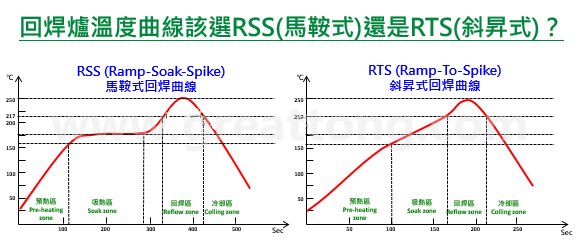
Should the reflow temperature profile be set to RSS type (saddle type) or RTS type (ramp-to-spike type)? TESDATA has found that many PCBA engineers are troubled by this question because some bosses require RTS, but they themselves are secretly worried.
Actually, answering this question is not difficult, but you must first understand what the "RSS type" and "RTS type" temperature profiles are. Only after deeply understanding the purpose and limitations of these profile settings can you choose a reflow temperature profile that suits your product.
In this article, TESDATA attempts to organize the characteristics of these two reflow temperature profiles, the "RSS type" and "RTS type," and the problems currently encountered with them, providing a direction for selection. TESDATA does not dare to claim that the following content is entirely correct; it merely presents personal viewpoints for your reference. Please think twice before adopting them.
RSS: Ramp-Soak-Spike 升温-吸热-回焊
Some people translate the "Soak zone" in the reflow profile as the "constant temperature zone," while others translate it as the "soaking zone," but Teacher Bai suggests translating it as the "heat absorption zone" or "activation zone." As the name implies, the temperature profile will have a flat constant-temperature section. Because the completed temperature profile resembles a "saddle" (the flat area can be sat on), the "RSS type" reflow temperature profile is also called the "saddle type."